


By Lawrence Odoom/Phalonzy
A compelling case for Technical and Vocational Education and Training (TVET) as the bedrock of employment, entrepreneurship, and national transformation was made to over 1,000 Junior High School candidates in the Mampong Municipal District of the Ashanti Region.
The appeal came at a Career Guidance Programme convened by the Nhyira Charities Foundation, designed to illuminate the critical nexus between education, skills acquisition, and sustainable economic growth.
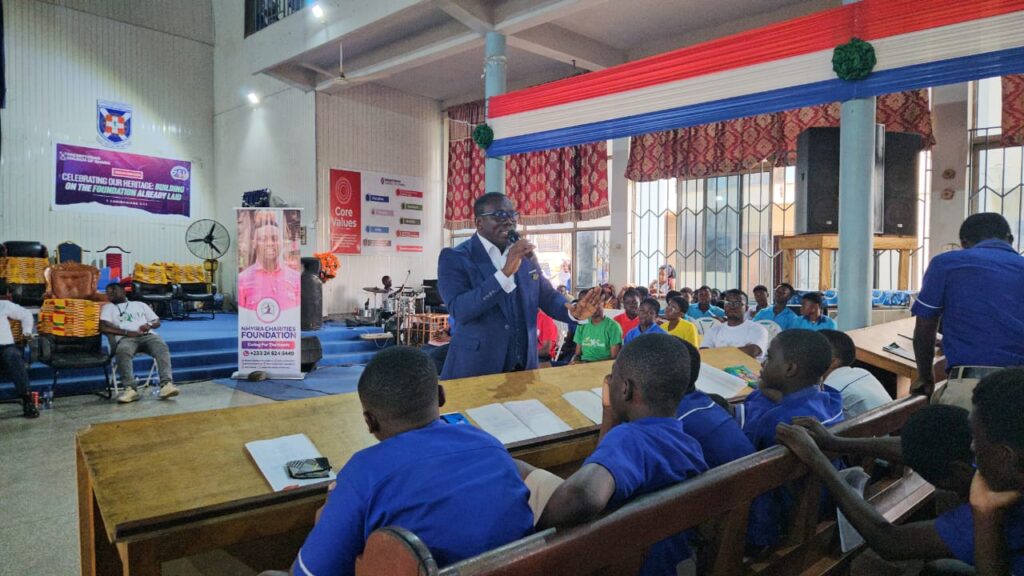
Delivering the keynote address, Dr. Patrick Essien, Founder of Molex Foundation Africa and Deputy Director of the Mining Department at the Environmental Protection Authority, asserted that Ghana’s economic metamorphosis hinges on cultivating a proficient workforce capable of adding substantive value to the nation’s vast natural endowments.
Speaking on the theme “TVET as Ghana’s Economic Drive”, he observed that although Ghana is richly endowed with resources including gold, cocoa, timber, bauxite, oil, and agricultural produce, the nation continues to reap disproportionately modest dividends due to inadequate value addition.
He elucidated that genuine economic prosperity is realized when raw materials are transmuted into finished or semi-finished products through manufacturing, engineering, packaging, and innovation, rather than being exported in their crude state.
Dr. Essien identified deficient technical capacity and acute skills gaps as formidable impediments to Ghana’s industrial ascendancy, contending that TVET furnishes the practical competencies requisite to bridge these deficits. He spotlighted sectors such as engineering, construction, agriculture, mining support services, renewable energy, food processing, and digital technology as domains where skilled labor is urgently imperative.

He urged students to jettison the archaic notion that technical and vocational education is a secondary recourse, portraying it instead as a credible and strategic avenue for youth to attain productivity and self-reliance.
He further noted that many graduates grapple with unemployment because their academic training is misaligned with labor market exigencies. In stark contrast, TVET is anchored in hands-on expertise that directly addresses industry imperatives.
Dr. Essien also emphasized the exigency of equipping young people for a technology-propelled future, where mastery of automation, digital tools, and innovation will be indispensable.
As part of his address, he spotlighted initiatives spearheaded by Molex Foundation Africa to advance STEM and TVET education, with particular emphasis on girls. He cited the SHEROES in STEM programme, which delivers mentorship and training in robotics, coding, and artificial intelligence to narrow the gender chasm in technical disciplines.
He encouraged female students to pursue careers in science and technology, underscoring the necessity of inclusive participation in Ghana’s skills development blueprint.
Dr. Essien lauded the Nhyira Charities Foundation for convening the programme, describing it as opportune and consequential in guiding students toward informed educational and vocational choices at a formative stage.
The forum also served as a clarion call to parents, educators, and stakeholders to elevate TVET as a national imperative, amid mounting apprehension over youth unemployment and skills mismatches.
Organisers affirmed that the initiative seeks to imbue young people with pragmatic knowledge and catalyze a paradigm shift toward skills-based education, positioning them not merely to seek employment but to architect opportunities for themselves and others.