

By Leo Nelson
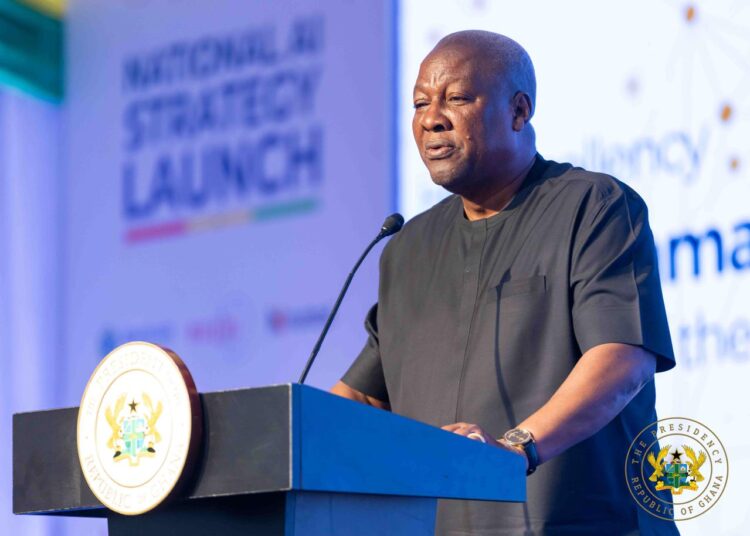
President John Dramani Mahama has announced a major $250 million investment to establish a world class Artificial Intelligence computing centre as part of Ghana’s newly launched National Artificial Intelligence Strategy.
The announcement signals a significant shift in the country’s approach to digital transformation, with a strong emphasis on infrastructure as the foundation for innovation.
Speaking at the official launch, the President underscored the growing importance of data, computing power, connectivity, and energy in shaping modern economies.
He explained that these elements now play the same strategic role in the digital era as roads, ports, railways, and power plants did in earlier phases of development.
“AI cannot thrive without infrastructure. Data, computing power, connectivity and energy are now as strategic to the digital age as roads, ports, railways and power plants were to earlier eras of development.”
Strengthening Ghana’s Digital Backbone
The proposed computing centre is expected to anchor Ghana’s digital ecosystem by providing advanced technological capabilities for research, innovation, and enterprise development.
According to the President, the government is taking deliberate steps to strengthen the national data centre and ensure that Ghana’s digital backbone is secure, resilient, and capable of meeting the increasing demands of AI systems.
He emphasized that the investment is not a short term intervention but part of a long term strategy to build a sustainable digital infrastructure. “We are building deliberately because infrastructure is the foundation upon which innovation rests,” he noted.
In addition to the $250 million allocation for the computing centre, government will commit a further $20 million to support the short to medium term implementation of the national AI strategy.
The combined investment reflects what the President described as bold but necessary financial commitments aimed at positioning Ghana competitively in the global digital landscape.
A Nerve Centre for Innovation and Enterprise
According to President Mahama, the AI computing centre is envisioned as a central hub that will enable Ghanaian talent to develop solutions tailored to both local and continental challenges.
By providing access to high performance computing resources, the facility will support cutting edge research and foster innovation across multiple sectors. The President explained that the centre will not only serve Ghana but also contribute to technological advancement across Africa.
“The proposed AI computing centre will serve as a nerve centre for research, innovation and enterprise, enabling Ghanaian talent to build solutions not only for our country but also for the wider African continent.”
This approach aligns with Ghana’s broader ambition to become a regional leader in technology and innovation, leveraging its human capital and institutional capacity to drive growth.
Partnerships as a Critical Enabler
While outlining the government’s commitment, the President acknowledged that the success of the AI strategy will depend heavily on collaboration among various stakeholders.
He noted that government alone cannot build a thriving AI ecosystem and called for partnerships with academia, civil society, industry, and international development partners.
He highlighted contributions from key institutions and partners, including the Ministry of Communications, Digital Technology and Innovation, as well as support from international organisations and academic institutions such as the Kwame Nkrumah University of Science and Technology.
“This strategy is itself the product of such collaboration,” he said, expressing gratitude to partners who contributed to its development. The President also extended an invitation to new partners to join the initiative, urging them to invest in Ghanaian talent and support local innovation efforts.
He emphasized that collective action will be essential in building an AI future that is inclusive, sustainable, and relevant to African realities.
Implementation Framework and Oversight
The National Artificial Intelligence Strategy will be implemented over a ten year period, with clearly defined targets and performance indicators across its various pillars.
To ensure effective coordination and accountability, the government plans to establish a Responsible Artificial Intelligence Office. This office will oversee implementation, coordinate stakeholders, and drive the achievement of the strategy’s objectives.
The President stressed the importance of disciplined execution, noting that progress will be closely monitored to ensure that the strategy delivers tangible results. “We intend to monitor progress closely and ensure that implementation remains disciplined and purposeful,” he said.
Looking ahead, the President outlined an ambitious vision for Ghana’s AI ecosystem by 2035. He said the country aims to build a comprehensive system that expands digital literacy, strengthens job creation, and promotes entrepreneurship.
The vision includes fostering innovation hubs beyond Accra, supporting universities to lead in advanced research, and enabling Ghanaian startups to compete globally. It also prioritises data sovereignty and the development of technologies that reflect Ghana’s linguistic and cultural diversity.
“We envision a future in which AI is embedded across our educational system, where innovation hubs flourish beyond Accra, where universities lead in frontier research, and where Ghanaian startups scale globally”.
Promoting Inclusion and Equity
A key element of the strategy is its focus on inclusion. The President emphasized that the benefits of AI must be accessible to all segments of society, including the informal sector and persons with disabilities. He also highlighted the importance of gender equity in the rollout of AI initiatives.
The strategy aims to ensure that technological progress does not exacerbate existing inequalities but instead serves as a tool for broad based development. By prioritising inclusive policies, the government seeks to create opportunities for all Ghanaians to participate in the digital economy.
Beyond economic growth, the AI strategy is expected to enhance the performance of the public sector. The integration of AI into government operations will improve efficiency, service delivery, and decision making processes.
The President noted that a digitally public service will be better equipped to respond to the needs of citizens and support national development objectives.
The announcement of the AI computing centre represents a significant milestone in Ghana’s journey toward digital transformation. By investing in infrastructure, fostering partnerships, and prioritising inclusion, the government is laying the groundwork for a resilient and innovative economy.
The President concluded by reiterating the importance of collective effort in achieving the strategy’s goals. He called on all stakeholders to work together to build an AI future that reflects Ghana’s values and aspirations.