

By Leo Nelson
President John Dramani Mahama has announced that government will train at least 300,000 beneficiaries in 2026 under the One Million Coders Programme, placing digital skills development at the core of Ghana’s newly launched National Artificial Intelligence Strategy.
The initiative, unveiled during the national launch, reflects a deliberate effort to harness the country’s youthful population and position Ghana as a competitive force in the global digital economy.
In his address, the President described Ghana’s youth as energetic, innovative, and increasingly engaged with digital technologies. However, he cautioned that this demographic advantage can only translate into national progress if it is supported by structured opportunities and targeted investment in skills development.
“This demographic strength can be one of our greatest national advantages in the age of AI, but youthful potential must be matched by structured opportunity”.
Expanding Access to Digital Skills
The One Million Coders Programme is designed as a large scale intervention to bridge the gap between potential and opportunity. Following a pilot phase conducted the previous year, the programme has now entered a nationwide rollout stage, with strong initial participation.
Government data indicates that over 100,000 applications have already been processed since the programme’s portal was opened. Participants can access more than 15 courses across 10 different disciplines, ranging from basic coding to advanced AI related fields.
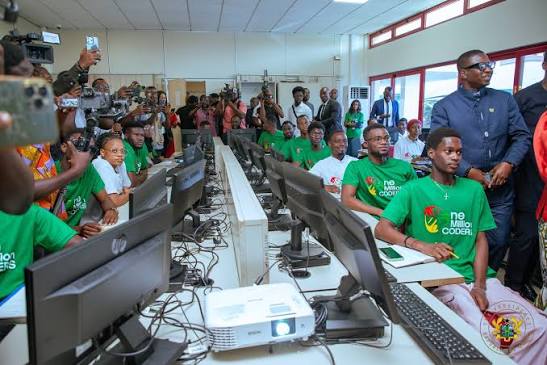
These courses are delivered through decentralised learning centres located across the country to ensure accessibility for participants in both urban and rural areas.
The President emphasized that the programme is about more than statistics. “These are more than just numbers. They represent opportunity, employability, and national preparedness,” he noted.
A central theme of the President’s address was the need for Ghana to move beyond being a passive consumer of digital technologies. He stressed that the country must develop the capacity to build, govern, and improve AI systems in ways that directly address local challenges.
This vision aligns with the broader objectives of the national AI strategy, which seeks to foster innovation and entrepreneurship while strengthening Ghana’s technological independence.
By equipping young people with relevant skills, the government aims to create a workforce capable of driving both economic growth and social development.
Addressing the Need for Localised AI
The President also drew attention to the limitations of existing AI systems, many of which are developed using foreign data sets and cultural assumptions. He warned that such systems may not adequately reflect Ghana’s linguistic diversity and social context.
“We cannot build a meaningful AI future using systems that do not understand our Ghanaian realities,” he said. To illustrate this point, he shared a personal example involving an AI application used to diagnose plant health.
While the tool successfully identified that a plant was being overwatered, its usefulness depended on the user’s ability to understand English.
He pointed out that for many farmers in rural areas, language barriers could limit the effectiveness of such technologies. “We must not only use AI, we must localise AI,” he emphasized, calling for investment in local data ecosystems and indigenous language integration.
The One Million Coders Programme is part of a broader strategy built on several key pillars, including ethical AI development, workforce readiness, industrial innovation, data governance, and improved public service delivery.
At the heart of the strategy is the recognition that human capacity is critical. Without skilled individuals, strong institutions, and reliable infrastructure, the benefits of AI cannot be fully realised.
The President stressed that the strategy balances ambition with responsibility, ensuring that technological advancement is inclusive and aligned with national values.
As Ghana embarks on this ambitious programme, expectations are high that it will transform the country’s digital landscape. By equipping young people with in demand skills, the government aims to create jobs, stimulate innovation, and enhance Ghana’s competitiveness on the global stage.
The initiative is also expected to reduce inequality by providing opportunities for individuals who might otherwise be excluded from the digital economy.