

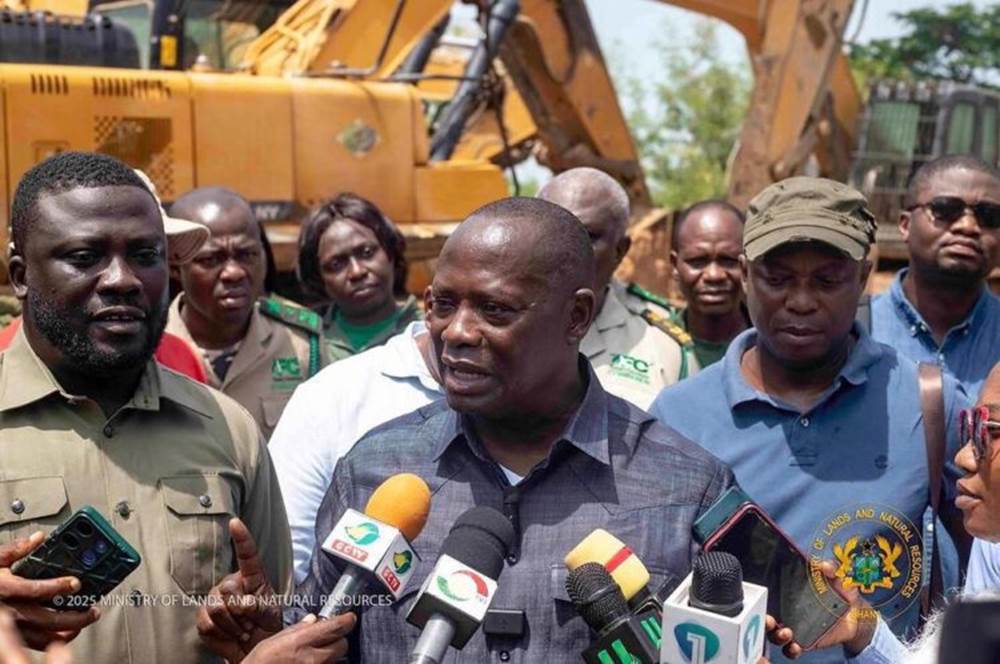
… Amid Adamus Mining Lease Revocation
By Leo Nelson
Ministry of Lands and Natural Resources is prioritizing job security for lawful workers as a core component of its decision to revoke the mining leases of Adamus Resources Limited for the Akango, Salman, and Nkroful concessions, citing confirmed breaches of Ghana’s minerals and mining laws.
This decisive regulatory action follows comprehensive investigations by the Minerals Commission, which established that the company facilitated widespread illegal mining activities, thereby compromising both legal compliance and the structural integrity of the sector.
“The Ministry assures that it will take steps to safeguard the lawful jobs and livelihoods of workers affected by this decision and will announce appropriate measures in due course.”
The revocation is fundamentally rooted in the government’s responsibility to uphold the Minerals and Mining Act, 2006 (Act 703).
According to the investigative findings, the company unlawfully sub-contracted operations without mandatory ministerial consent, failed to secure essential Environmental Protection Authority (EPA) approvals, and operated without valid permits from the Chief Inspector of Mines.
Furthermore, the reports revealed that the concessions were used to enable “galamsey” illegal, small-scale mining often involving foreign nationals which led to significant environmental degradation, including the pollution of water bodies and the destruction of local ecosystems.
The government’s pledge to protect affected workers is a critical component of its broader regulatory strategy.
In an industry where formal employment provides essential economic stability for local communities, sudden closures even those prompted by illegal corporate conduct can create immediate economic distress.
By signaling that it will take specific measures to mitigate the impact on lawful employees, the government balances the urgent need to enforce the rule of law with the social imperative of preventing collateral damage to the labor force.
This approach is essential for maintaining the credibility of mining governance in Ghana.
Allowing a mining entity to operate in flagrant disregard of safety, technical, and environmental regulations such as conducting “substandard” operations outside of designated mine infrastructure risks creating a “race to the bottom” in the sector.
Ensuring that regulatory enforcement includes worker protection frameworks prevents the perception that the government is indifferent to the livelihoods of the citizens it is simultaneously protecting from environmental harm.
The Ministry emphasized that this administrative revocation is not the final step in addressing the company’s non-compliance.
“The revocation is without prejudice to any criminal charges that may be preferred against Adamus Resources Limited, and their respective directors and management under the Minerals and Mining (Amendment) Act, 2019 (Act 995),” the statement noted.
This serves as a warning that the government intends to pursue full legal accountability for the “gravity and deliberate nature of these breaches.”
Legal experts often argue that administrative sanctions alone may be insufficient to deter corporate misconduct in the extractive industry.
By explicitly keeping the door open for criminal prosecutions, the Ministry is applying a multi-layered accountability approach.
This ensures that the repercussions for enabling illegal mining reach beyond the loss of assets, holding specific corporate leadership responsible for the damage inflicted upon the nation’s natural resources and public health.
The revocation of these specific leases functions as a potent signal that the government’s commitment to curbing illegal mining is not merely rhetoric.
Throughout the investigations, it was noted that the company’s actions posed severe, long-term risks to “public health and community livelihoods.”
By severing the legal authority for a company to operate on these lands, the state is actively reclaiming oversight of territory that had effectively been turned over to illegal extraction.
The government continues to reiterate its “unwavering commitment to safeguarding Ghana’s natural resources” and maintains that it will “continue to take decisive action against all forms of illegal mining.”
As the situation unfolds, the ability of the Ministry to successfully transition these sites or manage the aftermath will likely serve as a benchmark for how the state handles future cases of industrial non-compliance, particularly where large-scale operations have been compromised by illicit, decentralized activities.