

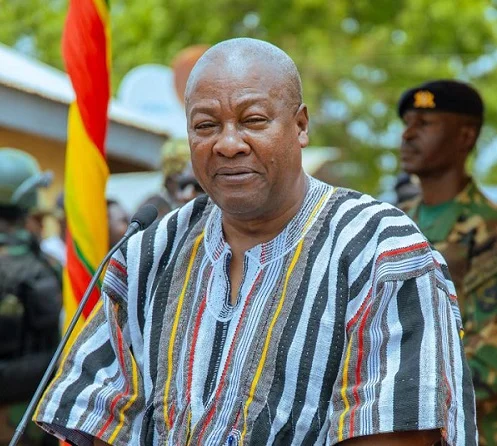
Two days, nine projects, one political message Marks ‘Resetting Ghana’ Presidential Monitoring
By Prince Ahenkorah
When President John Dramani Mahama touches down in the Volta Region today for a two-day “Resetting Ghana” tour, the official itinerary reads like a development parade: sod-cutting for a 24-hour market, inspection of a new college hall, road projects, a university lab, a hospital durbar, a sports stadium, a police headquarters, and a grand citizens’ engagement.
But beneath the polished schedule lies a more telling narrative. This is not merely a project inspection it is a political calibration, coming barely 18 months after Mahama’s return to power, and with the NDC keen to consolidate its base in a region that delivered him a decisive victory in 2024.
The Volta Region, historically a stronghold, has seen uneven development, and the President’s visit is as much about reassuring the faithful as it is about commissioning tarmac.
The centrepiece is the sod-cutting for the Juapong 24-Hour Economy Market a flagship of Mahama’s signature policy. But critics ask: where is the funding? The government has yet to release full costings, and the market’s viability depends on reliable power, security, and a night-time commercial culture that remains nascent in most Ghanaian towns.
Local traders in North Tongu, speaking to this newspaper on condition of anonymity, expressed cautious optimism but admitted to “broken promises” from previous administrations. “We’ve seen sod-cutting before,” one said. “We’ll believe it when the lights stay on at midnight.”
The 1,500-seater multipurpose hall at Peki College of Education is complete and ready for commissioning a rare success story. Yet educational stakeholders point out that the college still lacks a functional library and laboratory for science programmes.
The hall, while impressive, does not address the core teaching deficits that have plagued the institution for years. The President will likely celebrate the hall; he may not mention the broader underfunding of the country’s training colleges.
Road infrastructure the Asikuma-Anyirawase, UHAS By-pass, and Ho–Denu projects will be inspected. The UHAS By-pass has been on the drawing board since the Mills era; its current progress is still partial. The Ho–Denu road, a vital economic artery linking the regional capital to the border, has suffered years of neglect.
The Multipurpose Laboratory at UHAS’s Sokode Campus is meant to strengthen medical research. But university sources indicate that equipment procurement has lagged behind construction.
Without the specialised reagents and advanced instruments, the lab risks becoming a shell a familiar story in Ghana’s tertiary health infrastructure. The President’s inspection will be keenly watched for any commitment to operational funding, not just bricks and mortar.
The durbar at Ho Municipal Hospital is billed as a showcase for the free primary healthcare policy. Yet hospital administrators have privately raised concerns about the strain on staff and supplies, with the policy increasing patient numbers without corresponding increases in drug budgets.
The government has promised reforms, but the details remain vague. The durbar will likely be a photo opportunity; the real test will be whether the President offers concrete solutions for the overwhelmed district health system.
The inspection of the Ho Sports Stadium on Friday is symbolic. The stadium has been dilapidated for years, a relic of the 2000s. Mahama has pledged rehabilitation, but no budget line has been allocated. The visit is a way to acknowledge the problem but without a timeline or funding, it remains a gesture.
The climax the Resetting Ghana Citizens’ Engagement at Ho Technical University is where the President will face his most unpredictable audience.
Traditional authorities, students, and civil society have been invited, but the format is tightly managed. Will the President allow genuine feedback, or will it be a scripted exchange? In past tours by his predecesor, critical voices have been sidelined.
The test of “inclusive governance” will be in how the President handles uncomfortable questions about unemployment, the cost of living, and the slow pace of job creation under the 24-Hour Economy policy.
The commissioning of the Akatsi North District Police Headquarters at Ave-Dakpa is a welcome development for local security. But the force faces a deeper crisis understaffing, ageing vehicles, and low morale.
A new building without additional officers and logistics is like a car without an engine. The President will praise the structure; he may not address the systemic rot in the Ghana Police Service.
The itinerary is meticulously crafted to project progress but it also exposes the gaps. The Volta Region, despite its loyalty, still lacks a major industrial hub, reliable intercity roads, and a fully functional teaching hospital.
The “Resetting Ghana” agenda is heavy on ceremony, light on detail. For Mahama, this tour is an opportunity to listen but listening is only the first step.
The real reset will be measured not by ribbon-cutting, but by whether the 24-Hour market actually opens, whether the UHAS lab gets its reagents, and whether the Ho–Denu road is finished before the next election cycle.
The Volta Region has given Mahama its votes. Now it awaits deliverables. This tour, for all its fanfare, is a reminder that in Ghanaian politics, the distance between a sod-cutting and a functioning project is often measured in years and in broken promises.
The President has two days to narrow that gap. The region’s residents will be watching and judging long after the presidential convoy departs.