

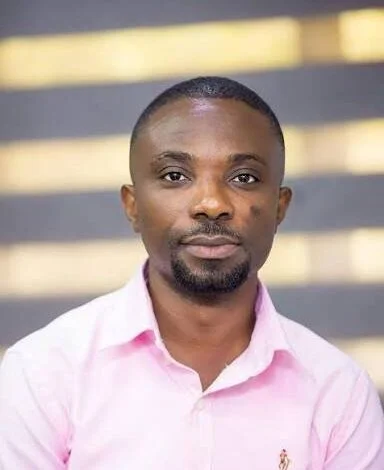
By Gifty Boateng
Dennis Edward Miracles Aboagye walked out of EOCO custody yesterday with a carefully crafted statement: the GH¢55 million figure that has dominated headlines was never discussed during his four-day detention. But in the same breath, he refused to disclose what was actually put to him leaving the public to choose between his word and the official account of the country’s premier anti-graft agency.
Aboagye’s Facebook post was emphatic: “FOR THE RECORDS: THERE WAS NO Discussion OF ANY GH¢55million with me by EOCO. None!!!” He described his arrest as an “unsuccessful attempt to intimidate” him and claimed it had only strengthened his resolve.
But the denial is a classic half-truth. By focusing solely on the GH¢55 million figure, Aboagye deflects from the broader investigation while offering no clarity on what questions were actually asked.
He has not denied being questioned about IMCCoD, the Secretariat where he served as Deputy Executive Secretary and where EOCO alleges that GH¢55 million in public funds was misappropriated, misapplied, and diverted between August 2022 and February 2025.
EOCO’s official statement, dated 13 July, is unambiguous. It states that Aboagye, along with former Accountant Gerald Appiah and others, is being investigated for conspiracy to steal, stealing, using public office for profit, causing financial loss to the state, defrauding by false pretences, and money laundering. The investigation stems from a forensic audit requested by the current Executive Secretary of IMCCoD, covering the period of Aboagye’s tenure.
Appiah, EOCO confirms, has already begun voluntarily refunding funds linked to the probe a move that does not absolve him of criminal liability but suggests that the investigation has substance. Aboagye, by contrast, has offered no such cooperation, only a blanket denial that does not address the specifics of EOCO’s allegations.
The NPP’s response to Aboagye’s arrest has been a masterclass in shifting narratives.
First, they claimed he was being silenced for being a vocal critic of the Mahama government. When that narrative failed to gain traction, they pivoted to a new theory: that his arrest was timed to derail his declared bid for the National Communication Director slot at the party’s September delegate conference.
But the chronology undermines both claims. Aboagye was arrested on Saturday, 12 July, while returning from the US. The brief video announcing his detention was released the following day, Sunday. The timing suggests a deliberate operational decision by EOCO, not a spontaneous political ambush. If the arrest was politically motivated, it was executed with remarkable precision but that does not make it illegal.
What is undeniable is that Aboagye has used his detention to bolster his political profile. His defiant statement, his refusal to disclose the substance of the interrogation, and his martyr-like framing all serve to position him as a victim of state overreach, not a suspect in a financial crime. The Communication Director slot is still open, and Aboagye is clearly auditioning.
Aboagye’s selective denial has created a vacuum, and the public is filling it with questions. If EOCO did not discuss GH¢55 million with him, what did they discuss? Why was he held for four days if the figure was never raised? And why has he not issued a categorical denial of involvement in IMCCoD’s financial irregularities, instead choosing to focus on a single number?
EOCO, for its part, has not yet responded to Aboagye’s claim. The agency’s silence is understandable investigations are ongoing, and prosecutors rarely engage in public debates with suspects. But the lack of a clear rebuttal allows Aboagye to dominate the narrative, and the public is left to guess who is telling the truth.
This is not the first time EOCO has faced a credibility challenge. The agency has a mixed record: effective in some high-profile cases, opaque in others. In this instance, its detailed statement on IMCCoD, complete with a named co-suspect, suggests a serious investigation with documentary evidence. Aboagye’s word alone may not be enough to counter that.
The core question remains unanswered: what happened to the GH¢55 million at IMCCoD? Aboagye’s denial does not address the forensic audit, the refunds by Appiah, or the allegations of procurement irregularities. It is a tactical evasion, not a substantive defence.
For now, the burden of proof rests with EOCO, and with Aboagye, who has been charged with nothing as of yet. But the public deserves more than a war of statements. It deserves a clear, transparent account of what was discussed in those cells and whether the man who served as Deputy Executive Secretary of IMCCoD has any answers for the missing millions.
This is not a political struggle; it is a matter of public accountability. And until Aboagye tells the whole story or EOCO releases the interrogation transcripts the public will remain in the dark, left to choose between a politician’s calculated denial and an anti-graft agency’s detailed indictment. Neither option is entirely convincing, and that ambiguity is itself a symptom of Ghana’s deepening crisis of institutional trust.