

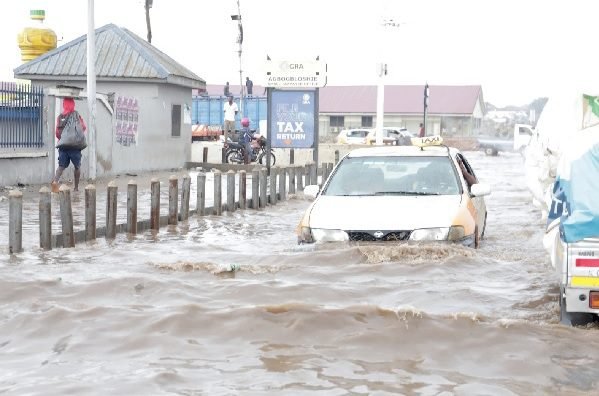
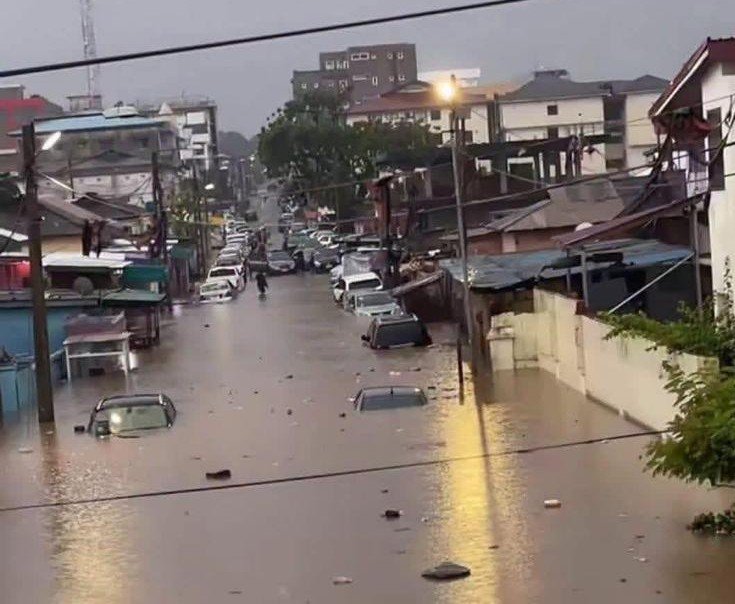
Ghana’s Presidency has issued an urgent appeal for residents in flood affected areas to remain vigilant and follow safety advisories closely, as hours of heavy rainfall left large sections of Accra submerged and brought traffic across the capital to a standstill.
Severe rainfall pounded Accra for several hours, triggering extensive flooding that submerged homes and clogged major roads with stranded vehicles.
The Accra-Kasoa highway, the N1 highway along the Apenkwa and Tesano stretch, and the area around the Kwame Nkrumah Interchange bore the brunt of the downpour, with floodwaters rising fast enough to trap motorists and disrupt entire neighborhoods.
Emergency services moved quickly once the scale of the flooding became clear. Firefighters and rescue teams have been deployed across the city to pull trapped residents and commuters from flooded homes and vehicles, with operations continuing in several hotspots as water levels remain high in some areas.
Widespread Disruption Across Major Routes
The flooding spared few corners of the capital. Major highways and roads bore heavy damage, with the Kasoa to SCC stretch, Weija, Mallam, North Kaneshie and the N1 all reporting severe flooding that made driving treacherous or impossible in places.
City centers and suburbs fared no better. Sections of Kwame Nkrumah Circle, Spintex, Atomic in Madina, Darkuman and Haatso experienced major traffic disruptions as inundated streets forced drivers to abandon their usual routes or wait out the rising water.
Direct Safety Guidance
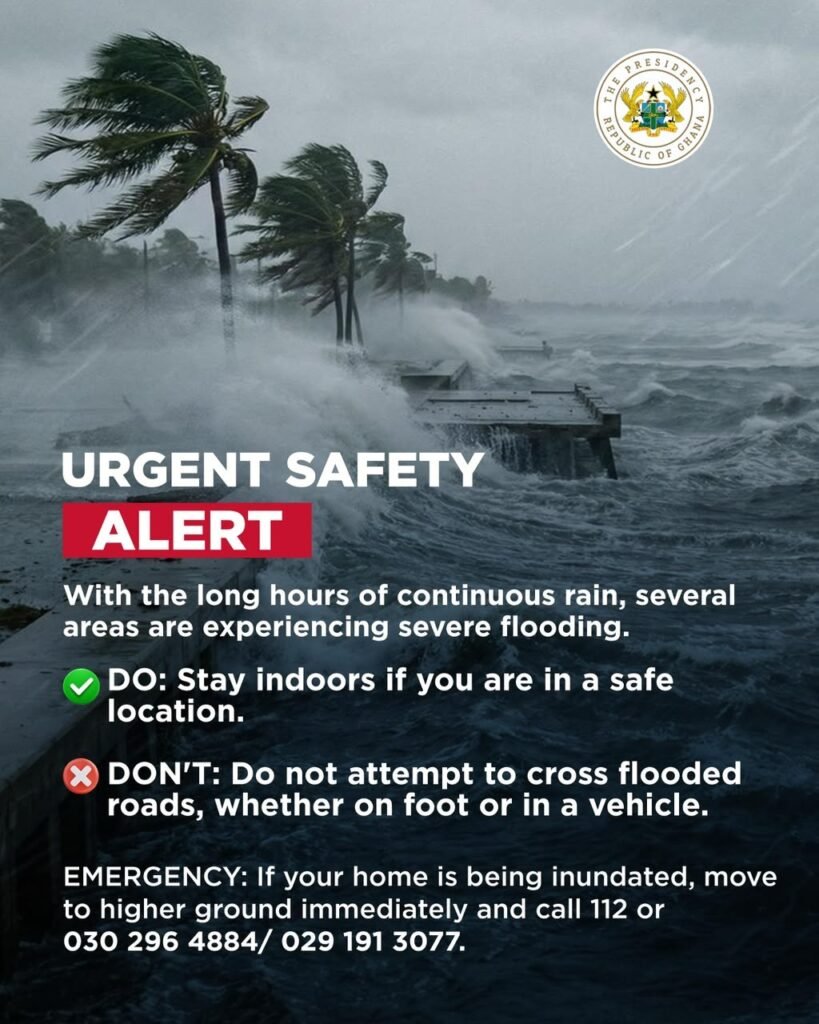
In its statement, the Presidency urged anyone currently in a safe location to remain indoors rather than attempt travel through the affected areas. The advisory was firm on one point in particular: residents should not attempt to cross flooded roads, whether on foot or in a vehicle, regardless of how shallow the water might appear.
For those whose homes are taking on water, the guidance was equally direct. The statement urged affected residents to move immediately to higher ground and call the national emergency line, 112, for assistance.
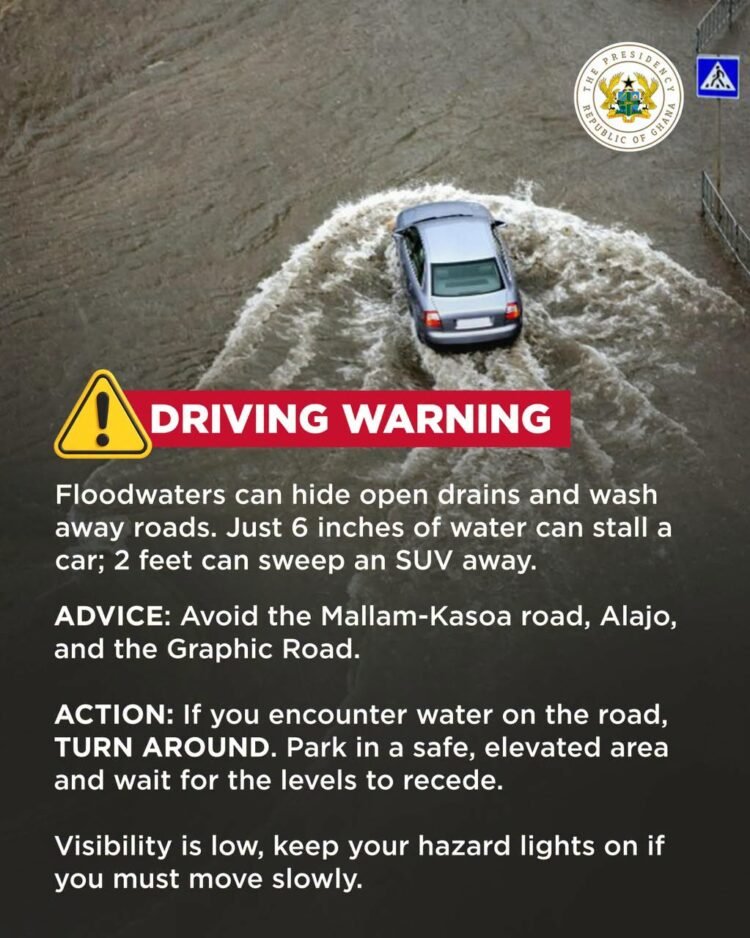
Motorists received specific route warnings as part of the advisory. The Presidency named the Mallam to Kasoa Road, the Alajo area and the Graphic Road area as routes to avoid entirely. Drivers who encounter floodwaters were told to turn around rather than push through and to seek a safe, elevated location instead.
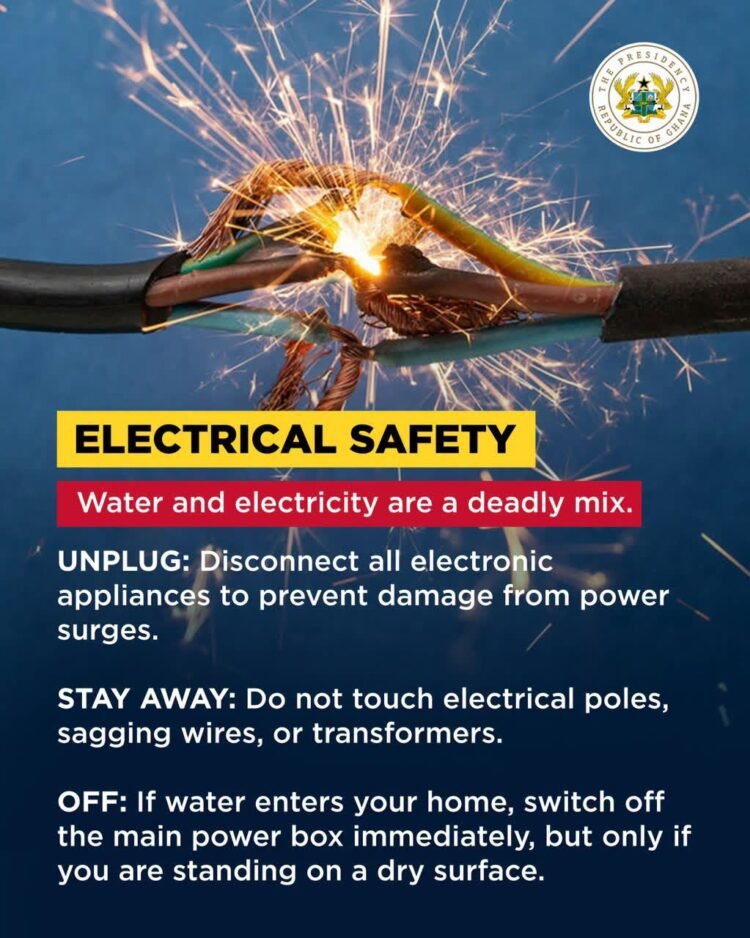
The advisory also addressed a less obvious danger tied to the flooding. The public was urged to unplug electrical appliances at home and to stay well away from electrical poles, transformers and any fallen power lines, since floodwater and live electrical equipment can combine into a serious hazard long after the rain stops.
“Your safety is paramount,” the statement read, closing with a call for residents to follow official updates and emergency directives as conditions develop.
Emergency Contacts and Continued Monitoring
Beyond the 112 emergency line cited in the Presidency’s statement, residents needing assistance can also reach the Police through 18555, 191 or 0302787373. Authorities have asked the public to keep these numbers accessible as rescue operations continue in the worst hit areas.
Officials are also recommending that residents work from home where possible until floodwaters recede and road conditions improve, easing pressure on emergency responders still working through affected neighborhoods.
The public has further been advised to monitor local news broadcasts for updates on road closures and weather alerts, since conditions in different parts of the city are changing rapidly as drainage systems struggle to keep pace with the rainfall.
A City Tested by Sudden Downpours
The scale of disruption underscores how quickly sustained rainfall can overwhelm Accra’s road network and drainage infrastructure, turning routine commutes into hazardous journeys within hours.
With multiple highways, interchanges and residential areas affected simultaneously, the response has stretched emergency services across several fronts at once.
For now, the Presidency’s message centers on caution rather than mobility. Residents in flood prone zones are being asked to wait, watch official channels and avoid unnecessary risk, while rescue teams continue working to reach those still affected by the rising water across the capital.