

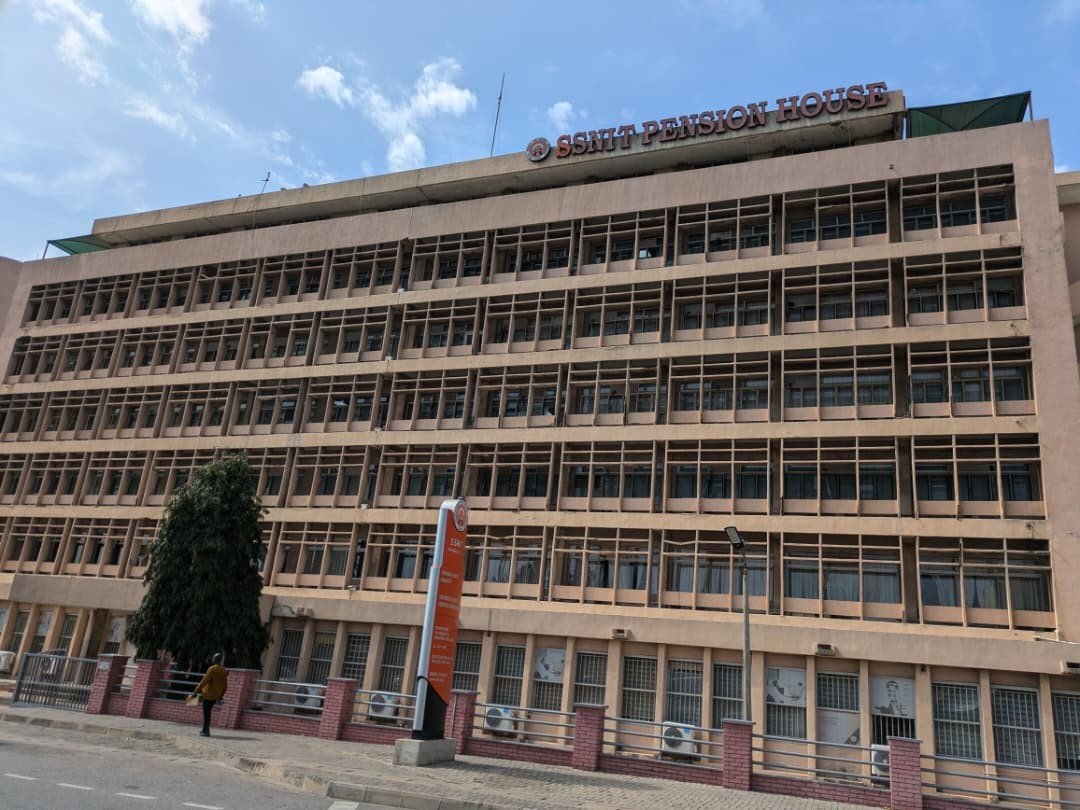
Empty Towers, Broken System, Pension Funds Risk
By Innocent Samuel Appiah
Accra is dotted with buildings meant to secure the future of Ghana’s workforce. But across the Social Security and National Insurance Trust’s (SSNIT) real estate portfolio, which is valued in billions of cedis, an alarming pattern has emerged: under-occupied properties, unresolved electromechanical failures, and developments that appear to have missed the market entirely.
What should have been a disciplined investment strategy to protect workers’ pensions is instead being tested by vacancy, malfunctioning facilities, and projects that have stalled or failed to attract buyers and tenants at expected levels.
SSNIT is not a private developer. It is a pension manager. Its decisions land in the lives of over a million active contributors and hundreds of thousands of pensioners who depend on SSNIT payments. When pension money becomes trapped in properties that remain vacant, or buildings that require rehabilitation but cannot complete it promptly, the risk becomes existential.
Vacant towers do not yield the returns that should strengthen pension stability. Defective infrastructure does not attract tenants. Delayed rehabilitation does not restore confidence. And mispriced housing does not convert buyers.
Vacancy at the Heart of the Crisis
At the centre of the credibility question is SSNIT’s flagship commercial asset: Premier Towers, adjacent to the SSNIT Pension House at the Ministries. The occupancy story is troubling. In 2024, the facility recorded an occupancy rate of 22.45%. In 2025, it remained stagnant at 22.45%. Yet by 2026, occupancy has dropped further to 15.94% a decline that signals a fundamental failure to convert premium assets into dependable income streams.
The problem is not merely financial; it is operational. SSNIT has acknowledged serious maintenance challenges. Tenants’ complaints include malfunctioning electromechanical installations such as lifts, generators, and air-conditioners failures that directly reduce tenant confidence and increase costs for anyone paying for space that doesn’t function properly.
According to SSNIT’s own feedback, the entire Premier Towers property has been earmarked for rehabilitation, with the Trust currently in the procurement process to engage a qualified contractor. But the real question remains: why were significant issues allowed to persist long enough to produce sustained low occupancy in the first place?
World Trade Centre: A “Premium” Building That Can’t Deliver
SSNIT’s World Trade Centre (WTC) adds another layer to the controversy. SSNIT’s position indicates the WTC currently has an occupancy rate of 19.24%. The maintenance failures at the WTC mirror those at Premier Towers, including malfunctioning lifts, generators, and a central air-conditioning system. SSNIT says the rehabilitation matter is connected to the 2026 budget, while awaiting management direction to proceed.
Even more striking is the inconsistency between “premium” pricing and the tenant experience, especially when electromechanical systems sit at the core of daily office operations. Tenants are not simply paying for a location; they are paying for a working environment that supports business continuity.
When those systems repeatedly fail, occupancy doesn’t just decline, it becomes inevitable. And while SSNIT claims it has maintained rental rates without reducing pricing, occupancy remains low. That mismatch high expectations on one side, underperformance on the other is exactly where pension trust credibility is put at risk.
Heritage Towers: Rehabilitation Promised, Rent-Generating Power Weak
The Heritage Towers occupancy figures recorded 59% in 2024 and 2025, declining slightly to 54.21% in 2026, still represent an under-leveraged asset relative to what such holdings are expected to deliver. Yet the maintenance issues are serious: electromechanical failures are again cited, including lifts, air-conditioners, and sanitary installations in parts of the building.
SSNIT has responded by engaging a consultant to provide pre and post-contract consultancy services for comprehensive rehabilitation, including completed design drawings and Bill of Quantities but tenders were unsuccessful, and SSNIT says it is awaiting management directive to proceed further. Even with progress on designs, the delay raises a pressing concern: how long can a pension fund remain exposed to income pressure while repairs remain in limbo? The result is predictable tenants hesitate, demand weakens, and occupancy stagnates.
Trust Towers: One Building Full, But the Story Still Highlights Institutional Gaps
Not every SSNIT property is failing in the same way. Even though it has been left unoccupied for several years, the Trust Towers is now described as being in good and tenantable condition, fully refurbished before occupation by the Trust Hospital, with maintenance responsibility assumed by the hospital. The structure is said to be effectively 100% occupied, except for the ground floor, which hosts a SSNIT branch office.
But this is less a resolution than an illustration of what SSNIT may have been missing elsewhere: when a clear operating framework and reliable maintenance ownership exist, occupancy is stabilized. In contrast, where electromechanical reliability is weak and rehabilitation timelines remain unclear, vacancy grows.
Adinkra Heights and Eden Heights: Projects Without a Market
Residential and mixed-use developments show the same pattern of miscalculation. For Adinkra Heights, SSNIT states that sales have not commenced. The Trust says there are no immediate development plans, despite the project having been conceived with a major vision including amenities such as a specialist hospital, school, and mall, among others.
The earlier relocation of occupants to a “new location” at SSNIT’s expense is now being criticized as a costly step that delivered little value adding another layer to the accountability challenge.
“In 2008, SSNIT entered into a joint venture (JV) with Lifeforms Limited (LF) and Trasacco Estate Development Company (TEDC) to form Switchback Developers Limited (SDL). The objective was to develop SSNIT’s 16.9-acre prime land at Switchback Road into a high-end mixed-use enclave comprising five residential blocks, two office towers, one five-star hotel, and one three-star hotel. TEDC and LF were the contractors responsible for design and construction. Shareholding structure: SSNIT is 70 per cent, LF is 15 per cent and TEDC is 15 per cent.
“The land was previously owned by the Government of Ghana and occupied by civil servants in six residential blocks. These tenants were relocated to 42 replacement units developed by SSNIT at Dunkonah, delivered to the Ministry of Water Resources, Works and Housing,” a Right to Information response from SSNIT and signed by its Information Officer, Emmanuel Kwesi Klu, stated.
According to SSNIT, the entity publicly advertised Expressions of Interest locally and internationally in October 2005, with four firms shortlisted: Taysec Construction Limited, M. Barbisotti & Sons Limited, Lifeforms Limited (with TEDC), and Buena Vista Homes Limited. Three firms submitted proposals by the 30th of August 2006 deadline. M. Barbisotti & Sons did not submit. An evaluation panel of internal and external experts recommended Lifeforms Limited (with TEDC) based on design suitability, financial compatibility, execution ability, and marketability. Subsequently, the SSNIT Board approved the partnership and authorized the formation of SDL.
For its Dunkonah Eden Heights, SSNIT’s pricing and market reception have reportedly been far from what ordinary Ghanaians can afford. Only a limited number of units have been recorded as sold, and the project is described as catering to a narrow segment rather than the broad population for whom pension systems ultimately exist. When pension fund investments drift toward luxury markets while occupancy remains weak or sales remain stalled, the fund’s social purpose protecting contributors gets sidelined.
Trust F-Line: Stalled Projects and Minimal Sales
The Trust F-Line Housing Project is described as stalled, with 55 units available and only one unit sold. When one-unit sales become the reality for a project supposedly built on long-term investor confidence, the core issue is not just sales strategy it is the entire assumption behind the development and pricing model.
The three-bedroom unit is currently being sold at GHc1,100,792.00 even though an earlier investigation a few years ago revealed that it used to go for $250,000, which experts say was too outrageous for the ordinary Ghanaian worker, and hence, could be the major cause for the poor patronage.
A Credibility Test for SSNIT
SSNIT has indicated responses such as rehabilitation plans, procurement of contractors, refurbishment timelines to follow once directives and tender processes are resolved, and adjustments including rent reductions and enhanced marketing in some cases. But the evidence presented by these occupancy declines and recurring electromechanical failures suggests that corrective action is arriving only after losses compound, raising a central question for oversight bodies and the public: Were these problems preventable? And if so, why did they persist long enough to damage the earning power of pension assets?
Accountability Must Match the Stakes
As Ghana watches SSNIT’s real estate portfolio wobble between vacancy and expensive rehabilitation, stakeholders are demanding more than statements they want clarity, timelines, independent verification, and a disciplined strategy aligned to both market realities and pension obligations.
Because if SSNIT cannot secure workable occupancy, functional infrastructure, and market-responsive developments, then the real estate portfolio stops looking like an investment engine, and starts looking like a liability that workers will ultimately pay for.
SSNIT’s real estate crisis is no longer a distant policy debate. It has become a national test of whether pension trust can manage assets responsibly, or whether contributors are being asked to absorb the consequences of institutional misjudgment.
This is the first in a series. In our subsequent publications, we will forensically examine each project, one after the other, to establish whether they remain viable assets or deepening liabilities for Ghanaian workers and pensioners.