

By Leo Nelson
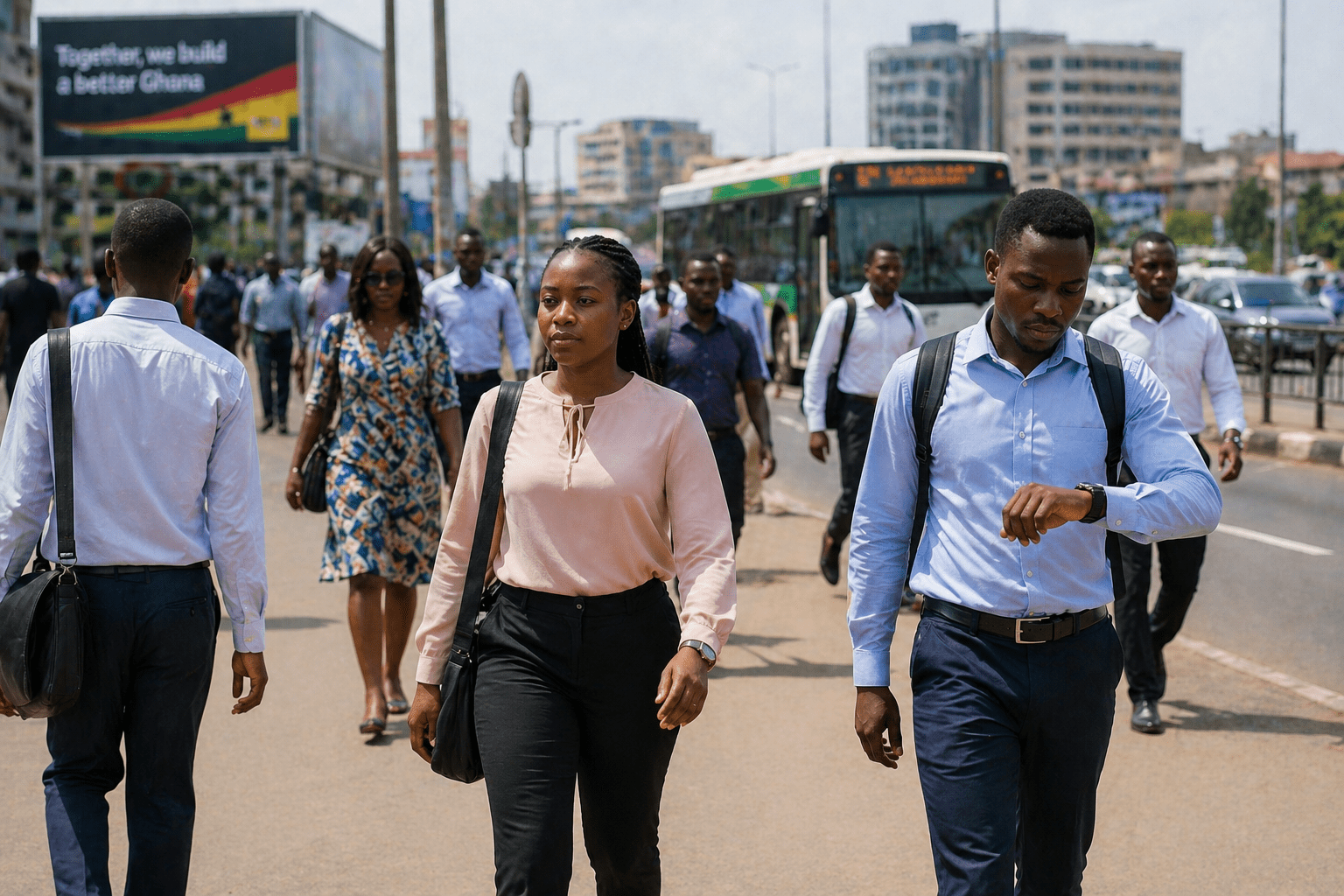
On a typical morning in Accra, the rhythm of work begins long before sunrise. From trotro stations to market stalls and office cubicles, millions of Ghanaians step into another day of labour with a quiet calculation at the back of their minds. It is not about profit or savings. It is about survival. The arithmetic does not add up, yet somehow, it continues to work. This is the paradox that defines the modern Ghanaian worker, a reality that has increasingly drawn comparisons to magic.
At the heart of this paradox lies a stark mismatch between income and expenditure. According to data from the Ghana Statistical Service, a significant proportion of workers, particularly in the informal sector, earn monthly incomes that fall below 1,000 Ghana cedis. Even within the formal sector, many entry-level salaries hover around 700 to 1,200 Ghana cedis. Yet, basic monthly expenses in urban centres such as Accra often exceed 2,000 Ghana cedis when transport, rent, food, utilities, and communication costs are combined.
The numbers become even more striking when placed alongside the statutory wage floor. Ghana’s national daily minimum wage currently stands at 21.77 Ghana cedis, set by the National Tripartite Committee and effective from January 2026. This translates to roughly 580 to 650 Ghana cedis per month, depending on the number of working days, an amount that falls significantly below the estimated cost of living in major cities. In effect, the legally permissible baseline income in the country is still far short of what is required for a basic standard of living.
The question that emerges is both simple and unsettling. How do workers bridge the gap between what they earn and what they spend?
Part of the answer lies in the structure of Ghana’s economy itself. The International Labour Organisation has consistently highlighted that over 80 percent of Ghana’s workforce operates within the informal sector, where incomes are unstable and social protections are minimal. In such an environment, financial planning becomes less about long-term security and more about daily improvisation.
Households rely heavily on what economists describe as coping mechanisms. These include borrowing from friends and family, purchasing goods on credit, reducing meal portions, or postponing essential expenses such as healthcare. The World Bank, in its assessments of living conditions in Sub-Saharan Africa, notes that many urban households survive through a combination of multiple income streams and informal support networks rather than a single stable salary.
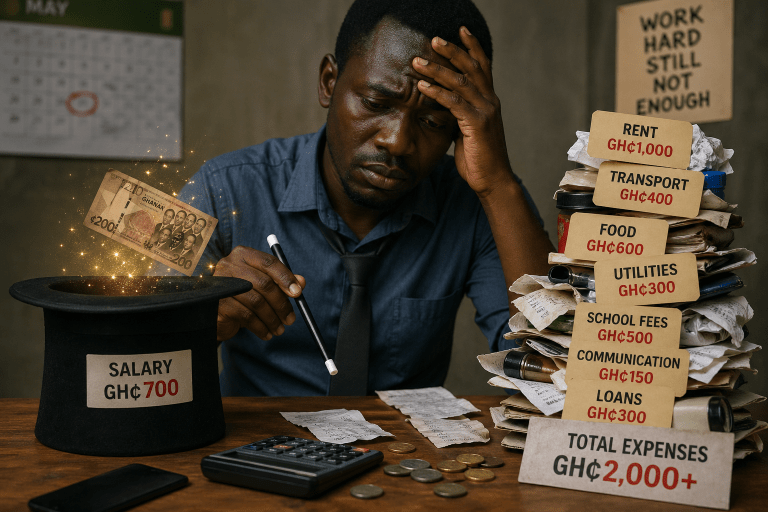
The Ghanaian worker stretches every cedi through strategies that are as creative as they are precarious. Meals are skipped so children can eat. Transport fares are negotiated. Side hustles emerge after long workdays. Each decision is a quiet act of balancing an equation that refuses to balance.
As Ghana marks International Workers’ Day, the celebration of labour takes on a deeper meaning. Beyond the parades and speeches lies a pressing national conversation about the sustainability of this “magic.” The ability of workers to continually absorb economic shocks without structural change raises important questions about wage policies, social protection systems, and the future of work in Ghana.
For now, the illusion holds. The worker earns 700 and spends 2,000, not because the numbers align, but because survival demands it. Beneath this illusion is not trickery, but a testament to endurance. The real question is how long this performance can continue before the system itself demands a different kind of transformation.