

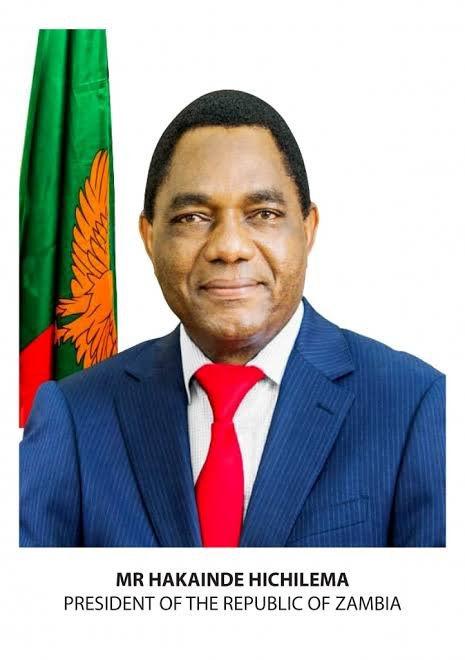
Hichilema faces election-day storm as repression claims Swell
TNR Files
Zambia heads to the polls on Thursday with President Hakainde Hichilema seeking a second term, but an election once expected to reinforce the country’s reputation for peaceful democratic transfers of power is taking place amid growing allegations of intimidation, arrests and restrictions on political dissent.
Hichilema, who swept to power in 2021 after defeating then-President Edgar Lungu, is campaigning on his record of economic reforms, debt restructuring and efforts to expand Zambia’s copper production. But his government faces increasingly sharp criticism from opposition parties and human-rights organizations, which accuse the administration of using state institutions and laws to restrict political activity and silence critics.
Amnesty International, in a report issued just days before Thursday’s vote, warned that Zambia’s authorities have increasingly employed what it described as authoritarian practices against government critics, journalists, activists and opposition politicians. The organization said broadly worded laws, intimidation, harassment and surveillance have contributed to restrictions on freedom of expression, peaceful assembly and association.
The accusations strike at the heart of Hichilema’s political legacy. When he defeated Lungu five years ago, Hichilema presented himself as the democratic alternative to a government accused of suppressing dissent, abusing state institutions and using security forces against political opponents. His victory was celebrated as evidence that Zambia’s democratic institutions could withstand the pressures that had weakened them under the previous administration.
Now, some of the same criticisms are being directed at his government. The most serious allegations have emerged in the final days of the campaign.
Brian Mundubile, the leader of the Tonse Alliance and Hichilema’s principal challenger, has accused the authorities of using arrests and alleged abductions to intimidate the opposition.
Mundubile has alleged that opposition figures have been detained or have gone missing, and has accused the government of attempting to silence opposition politicians, journalists, musicians and bloggers ahead of the vote. The allegations have been reported by African media outlets on the eve of the election.
The allegations are politically explosive, but they require careful qualification. There is currently a distinction between documented arrests and restrictions on political activity and claims of government-organized abductions. That distinction has become increasingly important as Zambia’s political parties battle over competing narratives about the state of democracy.
The Tonse Alliance has already accused the government of political suppression following a raid on its offices, an incident that has become one of the central points of contention between the opposition and the Hichilema administration.
Mundubile himself was detained and charged earlier this year in a case involving Zambia’s cyber-related laws, adding to opposition claims that the legal system is being used to constrain political challengers.
The allegations from Mundubile’s camp are not occurring in isolation. Zambia’s Human Rights Commission has reported reviewing 105 allegations of human-rights violations and abuses during its July 2026 review period. Sixty-two matters had been resolved while 43 remained under active consideration.
The Commission has also expressed concern over political violence, intimidation, hate speech, threatening rhetoric and online abuse during the campaign.
Those findings provide an important independent dimension to the debate. The concerns are not limited to accusations made by Hichilema’s political opponents.
The civic space watchdog CIVICUS has likewise warned that legislative and administrative measures adopted in recent years have contributed to a narrowing of political and civic space ahead of the election.
Human Rights Watch has previously documented harassment and arrests involving journalists covering opposition activity, as well as broader concerns about restrictions on political expression and assembly under the Hichilema administration.
The political irony is difficult to ignore. In 2021, Hichilema’s election represented a dramatic rejection of Lungu’s increasingly authoritarian style of government. His victory was widely viewed as a demonstration that Zambia remained capable of peaceful democratic change despite years of political tensions.
Five years later, Hichilema is the incumbent defending his record while his opponents accuse his administration of reproducing some of the very practices for which the previous government was condemned.
Amnesty International has now explicitly warned that Zambia risks reversing human-rights gains and called on political actors to reject authoritarian practices before, during and after Thursday’s election.
The comparison, however, is not absolute.
Zambia has not descended into the kind of widespread electoral violence or political instability seen in some other African states. The campaign has remained competitive, opposition parties have continued to operate and Hichilema’s final rally in Lusaka on Tuesday drew tens of thousands of supporters.
The question therefore is not simply whether Zambia is becoming a dictatorship.
It is whether the country’s democratic institutions are becoming less tolerant of dissent under an incumbent who once campaigned as their defender.
Religious leaders have increasingly intervened as concerns about political violence have grown. Catholic bishops have called for violence-free elections, while church leaders have mounted peace initiatives ahead of Thursday’s vote.
The interventions reflect a broader concern that political competition could undermine Zambia’s long-standing reputation for relative political stability.
The Human Rights Commission’s warning about hate speech and inflammatory rhetoric has added to those concerns. For a country that has largely avoided the large-scale political bloodshed experienced elsewhere in the region, the warnings are significant.
The election is not being fought exclusively over democracy and repression. Hichilema’s government points to substantial economic achievements since taking office, including the restructuring of more than $12 billion in debt and efforts to increase copper production. Zambia’s position as one of Africa’s major copper producers has also attracted increased international attention as demand for critical minerals grows.
But the economic recovery has not eliminated public frustration.
Food and energy costs remain important concerns for voters, and opposition parties argue that the benefits of the government’s economic programme have not reached ordinary Zambians quickly enough.
The result is an election in which Hichilema is asking voters to judge both his economic record and his stewardship of Zambia’s democracy.
The decisive test will come not only at the ballot box but in what happens around it. In its last election, Zambia’s democratic reputation was strengthened by the peaceful transfer of power in 2021. A similarly peaceful election in 2026 would reinforce that reputation.
A contested election accompanied by intimidation, unexplained arrests or credible evidence of state interference could have the opposite effect.
For Hichilema, Thursday’s vote therefore represents more than a referendum on his economic performance. It is also a test of whether the politician who came to power promising to restore democratic accountability can convince Zambians and the wider region that his government has not begun to resemble the system it replaced.
Zambia goes to the polls on August 13 under that unresolved contradiction: a country still regarded as one of the region’s more stable democracies, but one increasingly confronted by allegations that the political space under its incumbent president is becoming narrower.