

By Gifty Boateng
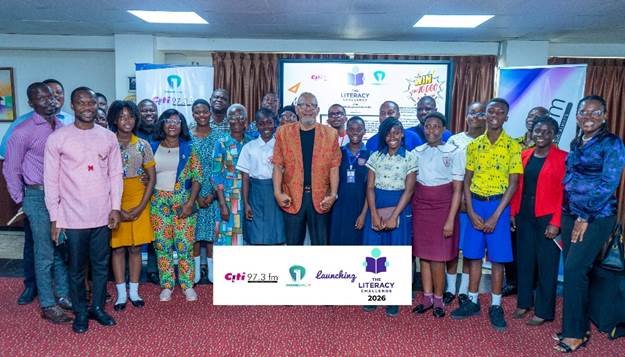
The 18th edition of the Citi FM and Channel One television’s Literacy Challenge, has officially been launched at Alisa Hotel, in Accra, bringing together, pupils, educationists, parents, institutions and other stakeholders.
The annual competition targeting pupils between the ages 11 to 14, is designed to promote and unearth extraordinary skills in writing, literacy and a host of other hidden talents.
Previously, the competition targeted only Junior High School (SHS) students but it has been expanded to attract more pupils nationwide and provide them a rare chance to display their skills and academic capabilities.
Launching the programme together with the General Manager of the two leading media organizations, Bernard Avle, Head of Programmes, Production Apiorkor Seyram Ashong-Abbey, provided details of this year’s contest which has been enhanced and it is expected to be keenly patronized.
According to her, the competition will be held in three phases. The first stage will require interested participants to submit essay on a specific topic.
The top which was unveiled read: In not less than 600 words, write a letter to the Minister of Education, as a Youth Consultant, discussing the advantages and disadvantages of the use of Artificial Intelligence (AI) in education. Advise on how Ghana can effectively integrate AI into basic schools to improve teaching and learning, while ensuring that students in rural and underserved communities are not left behind.
Contestants have three weeks to read around the topic and come out with the best essays. Deadline for submission is July 20. The examiners will select through the many essays and pick the top 100 for the next stage of the competition. The essay must be hand written, endorsed by a parent or guardian, full contact number.
The next stage will be a written aptitude test in Accra followed by the third and final stage where the contestants will be engaged in a live quiz competition focusing attention on General Knowledge.
“They don’t know where the questions are coming from. There’s reasoning, there’s language, there’s mathematical knowledge, scientific knowledge, current affairs, you name it, everything in there. And the top 10 contestants would have to compete live to see who the winner would become”, she said.
Since its inception in 2008, the programme has attracted pupils from all walks of life especially from 2017 to last year, where there have been strong representation from all the 16 regions.
The ultimate and most outstanding, all-round pupil will receive GHs10, 000, a laptop and a medal. That is not all. There will be rewards for top regional teams.
Chief Examiner, Anis Haffar, who has served as an integral part of the competition, shedding light on the topic noted that unlike in the past where learners struggled with information, things have changed with the advent of Artificial Intelligence (AI), google and so on.
“Remember in our time, information was sacrosanct. You could only get it from teachers or books. Then Google came along, and now AI has taken over. Every information under the sun is available,” he said.
He said, in as much as AI comes in handy and appears to solve many problems, not all societal problems can be solved using AI. He pointed out that there are real life situations that the technological tool cannot handle but requires critical thinking.
“So things have changed. So now what we’re looking for are the solutions to societal problems. Because these tools are available to us to use. So the idea now is this. What is it that we can do to make this happen? That one, AI cannot do for you. What is it that we can do to make this happen? And you know, I’ve been watching, but I’ve learned on the situation with the flood, for example, AI cannot solve that problem”, he said.
Haffar, who is also the founder of GATE Institute for Gifted and Talented Education added “What we are looking for now are solutions to societal problems, because these tools are available for us to use”.
He emphasized on the need to critically think how to solve the problems that confront society and do it internally.
“What do we value ourselves as human beings? What kind of people are we? What kind of people do we want to be? What kind of country do we really want to live in? So these are the challenges that are facing us today. And with critical thinking, what we do is that for the first time, we learn to think for ourselves.”
Executive Director of the Ghana Library Authority (GhLA), Alhassan Betintiche Ziblim, commended Citi FM and Channel One TV for embarking on such a project without the support of government.
He was particularly pleased about the fact that the programme is not based only in Accra or a few regions but nationwide, highlighting concerns of deprived areas and how important this is going to be for them.
He assured of the Authority’s support indicating their library spaces across the country are available for use and for free.
“So for us at the Ghana Library Authority, we want to congratulate you, and I assure you of our support. And I don’t know the plan you have for your national activities from the regions to Accra, we want to make available to you our library spaces across the country.
To help you organize these programs at the United States Library and Museums, so that we have a very safe, and a literacy environment to do this activity, and have the best of outcome”, he said.
Another partner, the British Council, said it associates with the Literacy Challenge because it remains a fundamental driver of educational advancement, social inclusion, and long-term national development.
Representative Mr Kwarteng said “The British Council recognizes the critical role that collaborative, well-structured programs such as the Literacy Challenge 2026 play in enhancing reading culture and improving learning outcomes. Among young people, we commend the organizers and all partners involved for their continued commitment to promoting literacy and educational excellence.”
He was hopeful that the launch will serve as a strong foundation for the successful implementation of the program. He was also excited about it nationwide nature. Just like the Ghana Library Authority, the official announced their facilities are available for use.
Indicating “We’ve already started conversations with Victor and Apiorkor on that. And you remain committed to this and we are ever ready to support this today. Let’s hear it. We have a lot of facilities to use”.
General Manager and host of the Citi Breakfast Show, Bernard Avle shared a personal story where he took part in a national competition and won at a time he did not believe he could and many didn’t think it was possible. He told the story stressing the importance of taking part in such a contest.
“So what I’ll urge you to do is, I think there’s more learning in joining the competition than there is in the joy of winning. I always tell people that the purpose of education is not accumulation of facts, it’s gaining confidence and experience. So it’s good to learn and write, but if you enter the competition, it will give you confidence before you go to secondary school”, he said.
The award winning morning show host said the AI conversation is so important that it needs not to be left in the hands of the developed countries.
He said Africa also needs to have a say in the AI discussion pointing out that this cannot be done by only the politicians. “We must decide our own future by what we do. And we can’t just write the AI strategy in Jubilee and impose it on you.”