

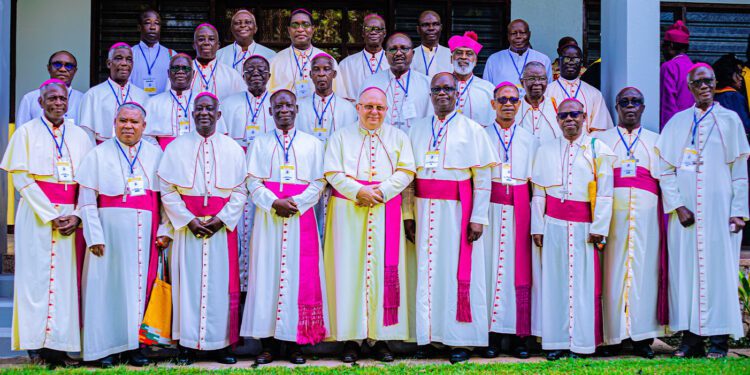
… It’s a moral duty to speak against galamsey
By Leo Nelson
The Ghana Catholic Bishops’ Conference has strongly defended the right of religious leaders to speak on national issues such as illegal mining (galamsey), insisting that the Church has both a moral responsibility and divine mandate to address matters affecting society and the common good.
In a statement signed by the President of the Ghana Catholic Bishops’ Conference and Bishop of Sunyani, Most Rev. Matthew Kwasi Gyamfi, the Conference responded to recent public comments directed at Apostle Eric Nyamekye, Chairman of the Church of Pentecost.
“Fellow Ghanaians and all people of goodwill, grace and peace to you from God our Father and the Lord Jesus Christ,” the statement opened.
The statement follows remarks reportedly made by Dr Mary Awusi, cautioning Apostle Nyamekye that if he continued speaking on matters such as illegal mining, commonly referred to as galamsey, “he should be ready to be treated as a politician.”
According to the Catholic Bishops, the comments generated significant public discussion and raised important questions about the role of religious institutions in national discourse.
The Church Cannot Remain Silent
The Bishops stressed that the Church cannot remain silent when confronted with moral and social challenges affecting the nation. Citing biblical teachings, the Conference explained that Christians are called to influence society positively by standing for truth, justice, and the protection of human dignity.
“Christ calls His Church to be ‘the light of the world’ and ‘the salt of the earth,’” the statement said, referencing Matthew 5:13 to 14. The Conference argued that issues such as illegal mining, environmental destruction, and threats to public welfare fall within the Church’s moral responsibility.
“Therefore, when issues arise that threaten human dignity, the integrity of creation, or the common good, such as the grave harm caused by illegal mining, the Church has both the right and the duty to speak.”
Per the statement, speaking against social injustice or environmental destruction should not be interpreted as partisan political activity. “This is not partisan politics. It is a moral responsibility rooted in the Gospel,” the Conference stressed.
Moral Guidance Not Political Power
The Catholic Bishops acknowledged that democratic societies require a distinction between political authority and religious leadership, but maintained that this distinction should not silence ethical or moral voices.
“The Church does not seek power but strives to illuminate public life with truth,” the statement added. According to the Conference, when the Church speaks on matters such as justice, peace, environmental protection, and human dignity, it acts as a moral guide concerned with the welfare of all citizens.
Remarks Described as Unhelpful
While acknowledging reports that Dr Mary Awusi had apologised for her comments, the Catholic Bishops expressed concern that such statements do not contribute positively to national dialogue.
The Conference warned that equating moral advocacy with political partisanship could discourage ethical reflection and weaken healthy democratic engagement.
“We do not expect such expressions from those entrusted with public responsibility. Rather, we encourage respectful and constructive dialogue”.
The Bishops further commended members of the Christian community for responding calmly and respectfully to the controversy. According to the Conference, the reactions from many Christians demonstrated maturity, solidarity, and discipline.
The Conference said the responses reflected important Christian values. “Such responses reflect solidarity and restraint, reminding us that Christian leadership requires both courage and charity,” the Bishops stated.
Call for Peace and Dialogue
The Ghana Catholic Bishops’ Conference urged citizens, political leaders, clergy, and civil society groups to use the moment to strengthen peace, dialogue, and mutual respect.
The Bishops encouraged Ghanaians to avoid actions or statements capable of creating unnecessary divisions within society. “Let us avoid division and promote dialogue, understanding, and mutual respect,” the statement noted.
The Conference also appealed directly to public officials to remain open to moral guidance from religious institutions and other groups advocating for the public good.
Religious leaders and lay Christians were also encouraged to continue speaking truthfully but with wisdom and love. “To clergy and lay leaders, we encourage fidelity in proclaiming the truth with prudence and love,” the Bishops stated.
The statement concluded with prayers for Ghana’s peace, unity, and leadership. “Finally, we entrust our beloved nation, Ghana, to Almighty God: May He guide our leaders and grant us unity and peace,” the Bishops said.