

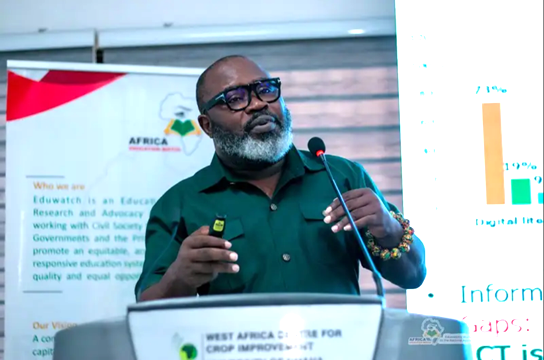
The Executive Director of Africa Education Watch (Eduwatch), Kofi Asare, has called for an urgent infrastructural drive to address the deep-rooted challenges facing Ghana’s public technical universities, warning that continued neglect will undermine the country’s tertiary education goals and its broader science and technology ambitions.
The Eduwatch Director’s remarks follow recent unrest at the Tamale Technical University (TaTU), where students have for years lamented deteriorating infrastructure and insufficient support from the government. He described the recent situation as unacceptable and a national embarrassment.
“We must not lose sight of the underlying reasons for the Tamale Technical University’s unrest. How can university students on campus be doing open defecation due to poor WASH facilities?”
He explained that the problem was not limited to TaTU but common across the country’s technical universities, noting that since their conversion from polytechnics almost a decade ago, most have seen “very little facility upgrade” despite their new status. This, according to him, has left them ill-equipped to function as proper universities.
Inadequate Funding:
The situation is further compounded by inadequate government funding. Kofi Asare observed that many of the institutions are compelled to rely on internally generated funds (IGF) to finance basic operations.
“With limited government funding, many rely on fees to run the schools, necessitating regular increments,” he said. But this reliance, he argued, places smaller institutions such as TaTU at a disadvantage due to their relatively low student numbers.
For instance, TaTU enrolls only about 8,000 students compared to larger universities such as the University of Cape Coast, which has over 70,000 students. The result is that the smaller institutions raise less money but face equally wide facility deficits.
Kofi Asare disclosed that in March 2023, TaTU students staged a one-week boycott of lectures to protest what they described as excessive fees, poor infrastructure, and unsatisfactory learning conditions.
According to him, the boycott highlighted the extent of the frustration among students and the pressure the administration faces in trying to keep the university running under financial strain.
Wake-up Call to Action:
For Kofi Asare, this must serve as a wake-up call to the government. He urged President Mahama’s administration to prioritize completing all stalled projects in technical universities and roll out a deliberate infrastructure upgrade across these institutions.
“The government must find money to complete all stalled projects in Technical Universities and upgrade to proper universities if Ghana is to get close to its 40% Gross Tertiary Enrollment and 60:40 STEM to humanities ratio target by 2030.”
Kofi Asare, however, was quick to acknowledge that these targets may already be out of reach. Eduwatch, he noted, has projected that Ghana has already missed both the Gross Tertiary Enrollment and the STEM-to-humanities ratio goals, even with six years left to the 2030 deadline.
“I said ‘get close’ because Eduwatch projects the targets have already been missed,” he emphasized. This, he argued, makes urgent reforms even more necessary, as delay only worsens the deficits and the long-term consequences for national development.
Beyond infrastructure, Kofi Asare underscored the broader implications for Ghana’s socio-economic future. Technical universities are critical in training middle- and high-level manpower in science, technology, engineering, and applied fields that directly feed into industry.
Ghana’s Industrialization Agenda at Risk:
Without the required facilities, he warned, the institutions cannot effectively deliver, thereby threatening the realization of the country’s industrialization agenda. He insisted that the challenges must not be treated as routine or localized to TaTU but should be addressed as a systemic issue undermining the credibility of all technical universities.
Civil society actors, student groups, and education stakeholders have long urged the government to treat technical universities as a strategic national investment rather than a budgetary burden.
They argue that Ghana’s ambition of achieving a sustainable 60:40 STEM-to-humanities ratio by 2030 will remain a mirage unless technical universities receive the necessary support to compete with their traditional counterparts.
As discontent simmers across campuses, the government faces growing pressure to prove its commitment to education reform not just in rhetoric but through immediate resource allocation.
For Kofi Asare and Eduwatch, the stakes are high. Without decisive action, the frustration of students, the financial struggles of administrators, and the decay of facilities could worsen, further widening inequality across the tertiary landscape.
His call is clear: Ghana cannot achieve its vision for tertiary education without making bold, targeted investments in its technical universities. Anything short of this, he cautions, would be a betrayal of the promise made to young people and a setback for the country’s developmental aspirations.